By William Alkhoury 03-June-2026
Who am I—really?
What is the “real” self?
What does it mean to “Know Thyself”?
Or to transcend the self?
The Tension
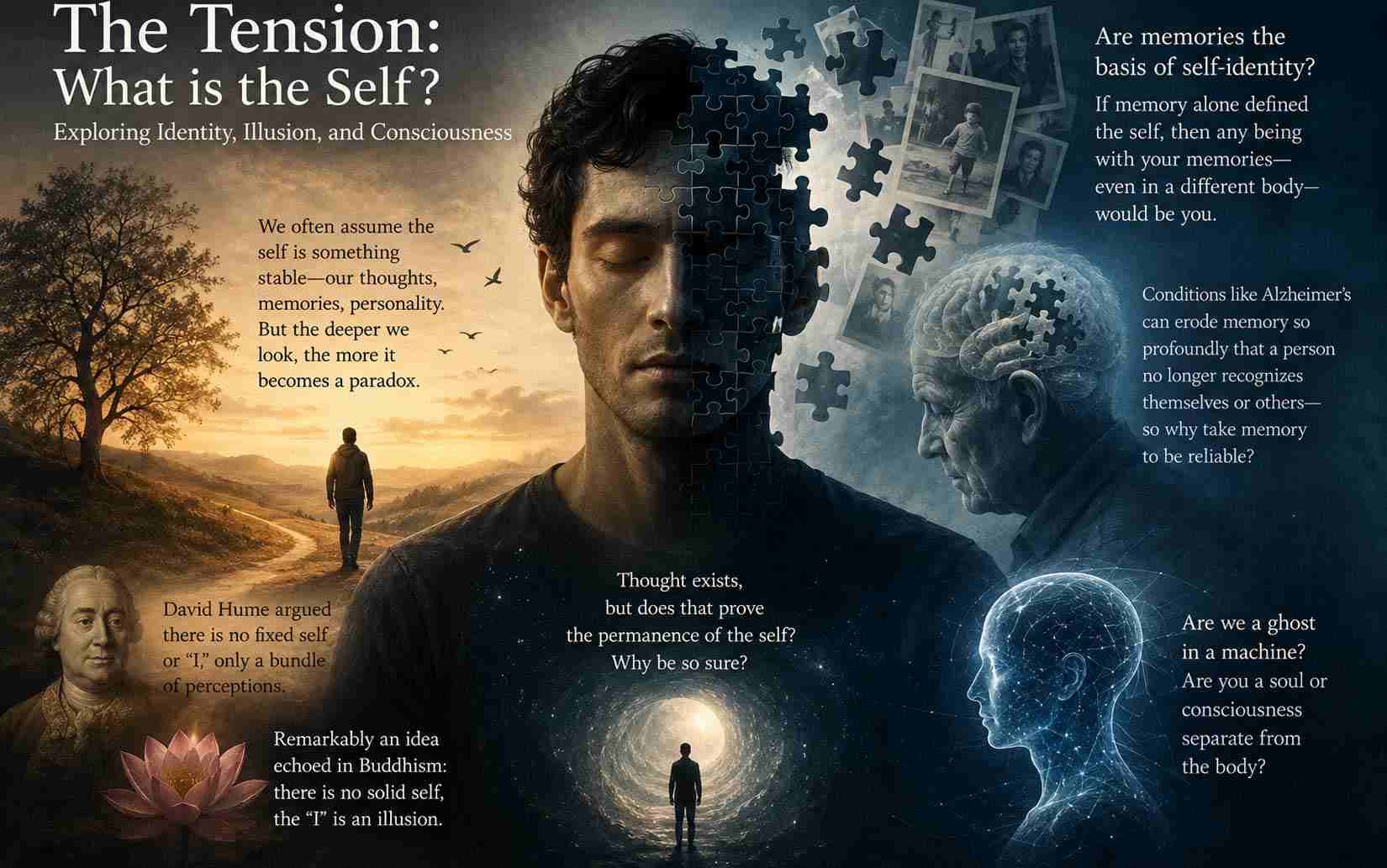
We often assume the self is something stable—our thoughts, memories, personality.
But the deeper we look, the more it becomes a paradox. If the self were any single trait, it would remain fixed. Yet everything about us changes.
Are memories the basis of self-identity? If memory alone defined the self, then any being with your memories—even in a different body—would be you.
Conditions like Alzheimer’s can erode memory so profoundly that a person no longer recognizes themselves or others—so why take memory to be reliable?
Philosophers like David Hume argued there is no fixed self or “I,” only a bundle of perceptions.
Remarkably an idea echoed in Buddhism: there is no solid self, the “I” is an illusion.
Thought exists, but does that prove the permanence of the self? Why be so sure?
Are we a ghost in a machine? Are you a soul or consciousness separate from the body?
The Existential Theory of the Two Selves
We can understand two dimensions of the self:
1- Self-as-object: our body, thoughts, memories, roles, emotions, and personality.
2- Self-as-subject: the center of awareness that observes—the “I” that chooses and experiences.
We suffer when we confuse the self-as-object for all of who we are.
Self-transcendence is often described as ego dissolution. But the real question is: who is doing the transcending? The answer: I am—the self-as-subject. *
Growth begins when we loosen identification with only the self-as-object and recognize ourselves as the self-as-subject in relationship to it.
This shift—from self-as-object to self-as-subject—is the essence of self-transcendence.
Closing Questions

Descartes said, “I think, therefore I am…But what then am I?”
Works Cited:
Branden, Nathaniel. The Art of Living Consciously. New York, NY: Fireside, 1997. *
Solomon, Robert C. The Big Questions: A Short Introduction to Philosophy. 5th ed. Orlando, FL : Harcourt Brace & Company, 1998.