By William Alkhoury 05-June-2026
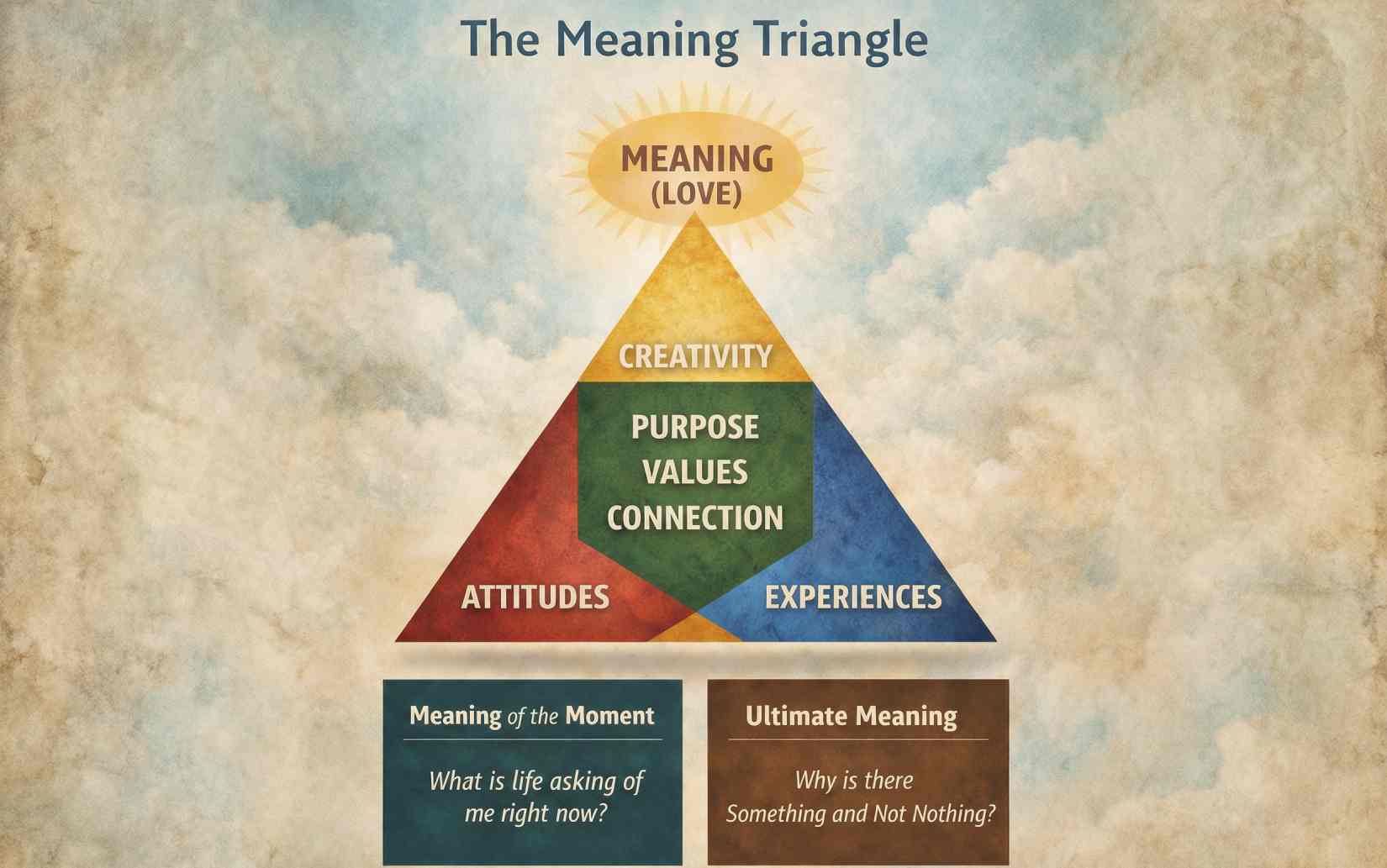
Viktor Frankl taught that meaning can be discovered through three primary pathways: creativity, experiences, and attitudes.
1. Creativity: Becoming Who You Are (What We Give to Life)
Meaning emerges through what we create and contribute. Creativity is not limited to artists. It includes raising a child, building a business, developing skills, helping others, writing, teaching, or pursuing any project that expresses our unique, innate gifts. Through creativity, we participate in the lifelong process of self-actualization—becoming who we are meant to be and bringing our potential into reality.
2. Experiences: What We Receive from Life
Meaning is also found in what we encounter and receive. If we want to live a meaningful life, we ought to have more meaningful life experiences. Some are extraordinary—love, the birth of a child, awe, beauty, and peak experiences. Others are simple—a sunset, a moment of gratitude, a shared laugh, or a meaningful conversation. Above all, meaning is often found in relationships: with others, with nature, and with a higher power. Genuine I-Thou encounters remind us that reality is relational.
3. Attitudes: How We Respond to Life
The highest form of meaning arises when we face unavoidable suffering we cannot change. No one escapes pain, loss, guilt, failure, or death. While we cannot always choose our circumstances, we can choose our attitude toward them. Through courage, acceptance, defiance, tragic optimism, compassion, gratitude, and responsibility, we can transform tragedy into triumph, pain into an achievement, and suffering into success. This is the alchemy of the human spirit.
The Meaning of the Moment
Frankl believed that the meaning of life is not a single answer but a series of unique possibilities that change from moment to moment. Life continually asks us questions, and meaning is found in responding to the task before us right here and now.
The Ultimate Meaning of a Unique Life
The ultimate meaning of our lives is not something fully revealed at the beginning, but something that gradually emerges through living and unfolds over time. Each human life is a singularity, unique, and unrepeatable. As Kierkegaard suggested, life can only be understood backward but must be lived forward. We may never fully know our purpose in advance, but we can trust the unfolding path and respond faithfully to what life asks of us today.
Ultimate Meaning: Living the Mystery
Beyond the meaning of the moment lies the mystery of existence itself. Why are we here? Why is there something rather than nothing? As Heidegger observed, we find ourselves "thrown" into a life we did not choose—into a particular body, family, culture, and moment in history. Yet we do not need to solve the mystery of existence to live it meaningfully.
Viktor Frankl believed that ultimate meaning transcends human understanding. We may never fully grasp the highest purpose of existence, but we can trust that life possesses a deeper order and significance beyond the limits of our immediate comprehension. For Frankl, love represents humanity's highest aspiration—the capacity to see and call forth the highest potential in ourselves and others.
From an Eastern perspective, ultimate reality cannot be fully captured by ideas or language. Asian philosophy tends to reject concepts as ultimate truth. The Tao, for example, is not a transcendent creator standing apart from the world, but is generative within the living process through which the universe unfolds. It nurtures all things without preference, sustaining life through mutual interdependence.
What appears as “cold,” cosmic indifference may, from another perspective, be a form of universal care. The Tao does not take sides, intervene, or show favoritism. Yet precisely because it excludes nothing, its absolute impartiality becomes indistinguishable from unconditional love.
Whether viewed through Frankl's language of meaning and love or the Taoist vision of harmony, compassion, and interdependence, both perspectives suggest that reality is not moving toward chaos alone, but toward greater wholeness, freedom, relationality, and creative participation in a mystery far larger than ourselves.
Author’s Note
This work was conceived, directed, and edited by the author. Artificial intelligence tools (ChatGPT, OpenAI) were used as collaborative aids for brainstorming, drafting, image generation, organization, and editorial refinement. All ideas, interpretations, revisions, and final content decisions remain the responsibility of the author.