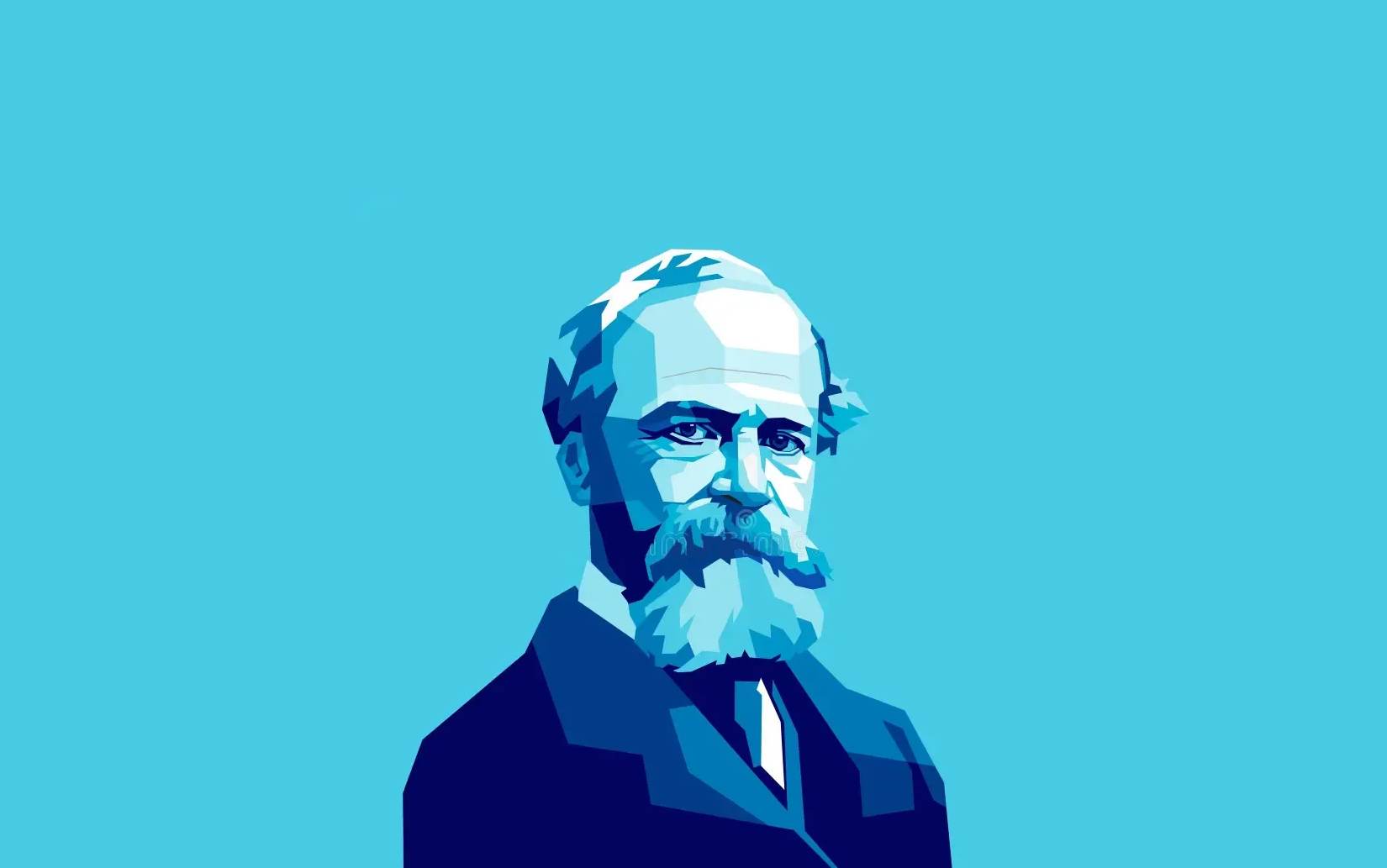
By William Alkhoury 11-June-2026
A Question by William James:
Do we discover truths in which we believe or do we create truth?
Is it better to believe a useful “lie” than a “truth” that leaves you empty?
William James practiced what he preached: it is better to passionately believe in a personally useful and NECESSARY LIE than a destructive and unnecessary truth.
The Tension: Forced Options
We have a right, and obligation, to ask, what difference do beliefs make in daily life? How is my life different if a tree falling in the forest makes a sound? What practical difference does it make if mind and body are separate?
Because life demands a response. We have no choice but to believe something whether we want to or not (even “not deciding” is a decision).
We cannot remain detached, life simply does not allow it. We are compelled to act on what we believe.
The demand for certainty cannot be met, yet we continue to live and act without it.
James’ Pragmatic Philosophy
William James was the original and founding advocate of pragmatism — an empirical philosophy that defines knowledge and truth by practical consequences.
- For James, “the truth” is not the chief value; what matters is usefulness but in the moral sense.
- Beliefs are justified when they help us navigate our way through life.
- Our lives are shaped by beliefs we cannot fully confirm, and pragmatically, we need to believe in something more than science can ever “prove.”
Paradoxically, pragmatism works only if we believe in something beyond purely pragmatic justification.
Closing Questions:
Can we find values and beliefs worth living, fighting, or dying for without metaphysics?
If religious faith provides moral helpfulness, does it hold pragmatic value?
If deterministic, materialistic, and reductionistic beliefs undermine human happiness, then is disbelief necessary for psychological survival and vitality?
Works Cited:
Soccio, Douglas. Archetypes of Wisdom. Cengage Learning, 2015.
Solomon, Robert C. The Big Questions: A Short Introduction to Philosophy. 5th ed. Orlando, FL : Harcourt Brace & Company, 1998.