By William Alkhoury July 15, 2026
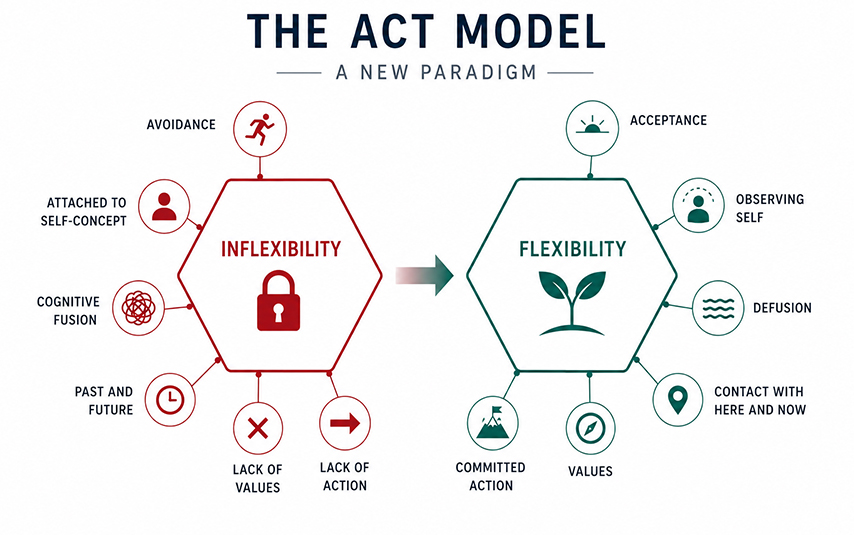
Much of psychology has traditionally focused on identifying symptoms, diagnosing disorders, and the removal of unwanted experiences. While these remain important, Acceptance and Commitment Therapy (ACT) offers a different lens. Rather than trying to eliminate negative thoughts or feelings, its goal is to cultivate psychological flexibility.
This represents more than a new therapy model—it represents a new paradigm.
Inflexibility: The Common Thread
Long before the ACT Model, psychologist Theodore Millon, a key contributor to the DSM-III and DSM-IV, recognized that psychological disorders share several fundamental characteristics. He described three common features:
1. Maladaptive inflexibility – difficulty adjusting to changing circumstances.
2. Instability under stress – functioning begins to deteriorate when life becomes difficult.
3. Vicious cycles – thoughts, emotions, and behaviors repeat and reinforce one another, keeping people stuck.
Although disorders differ in their symptoms, they often share one underlying quality: inflexibility.
Whether someone struggles with anxiety, depression, obsessive-compulsive disorder, paranoia, bipolar, personality disorders, or addiction, the mind often becomes trapped in repetitive ways of thinking and behaving that no longer serve life.
The ACT Model shifts the focus from trying to eliminate symptoms toward increasing psychological flexibility—the capacity to adapt, accept, remain present, choose, and commit to actions that align with personally meaningful values even when life is painful or uncertain.
The Palm Tree Lesson
Imagine two palm trees standing side by side as a hurricane approaches.
One tree is rigid, resisting every gust of wind. The other bends with the storm.
Which one survives?
The flexible tree.
Strength is often mistaken for rigidity. In reality, resilience comes from adaptive flexibility.
Psychological health works the same way. People who can acknowledge painful emotions without becoming consumed by them, adapt to changing circumstances, and remain connected to what matters most are often better equipped to withstand life's inevitable storms.
Flexibility is not weakness. It is one of the greatest forms of strength.
From Either/Or to Both/And
Psychological flexibility also changes how we think.
Rigid minds often see the world through an either/or lens:
- I am successful or I am a failure.
- Someone is good or bad.
- I am happy or my life has no meaning.
- I am certain or I cannot move forward.
The ACT Model encourages a different way of thinking: both/and.
I can feel anxious and still pursue what matters.
I can experience grief and live a meaningful life.
I can disagree with someone and still respect that person.
This capacity to hold seemingly opposite truths without needing to eliminate one of them allows people to move beyond polarization and toward greater psychological freedom.
The Space Between "I-It" and "I-Thou"
Philosopher Martin Buber described two fundamental ways of relating to others.
In an I-It relationship, people become objects—labels, categories, problems to solve, to exploit, or opponents to defeat.
In an I-Thou relationship, we encounter another human being with openness, curiosity, compassion, respect, and genuine presence.
Psychological flexibility makes I-Thou relationships possible.
When we become less fused with our judgments and assumptions, we create room for empathy, dialogue, and authentic connection.
This applies not only to friendships and romantic relationships, but also to families, workplaces, and communities.
From Polarization to Renewal
The same principles that foster psychological flexibility within individuals can also strengthen families, communities, and society as a whole.
Today's culture often rewards certainty, outrage, and absolute thinking. Social media algorithms amplify extremes, making compromise appear like weakness and disagreement feel like personal attack. The cumulative effect is a culture where psychological inflexibility begins to take hold, weakening trust, cooperation, and the social fabric of society.
Rigidity creates polarization. It becomes easier to judge others, dismiss those with different views, it encourages either/or thinking, dividing the world into "us versus them." Projection and “other-ing” give way to dehumanization, making understanding and connection more difficult.
This pattern extends beyond politics and culture. Religious fundamentalism is a mode of cognition also characterized by psychological rigidity. An inflexible mind externalizes its own shadow, splitting the world into the “chosen” in-group versus out-group, requiring an outsider to stabilize identity, and cannot tolerate ambiguity, paradox, or competing truths. The orientation shifts toward law, obedience, and exclusive truth.
In cognitive psychology, this pattern is known as black-and-white thinking (or all-or-nothing thinking)—a common cognitive distortion that reduces complex realities into rigid extremes. But psychological flexibility offers another way. It reminds us that no one has all the answers. No one has the ultimate truth. Everything ends in mystery.
Flexibility invites curiosity, openness, and a willingness to revise our views in the light of new evidence. Flexibility creates dialogue and healthy debate. We can listen, consider the facts, and be willing to change our minds. We can disagree without dehumanizing or seeing each other as enemies. Instead of demanding unanimity, we can trust the democratic process to deliberate, vote, and move forward collectively.
The American tradition of democratic debate has always depended on this capacity. Democratic society was founded upon egalitarian rationalism, free thinking, and intellectual equality, principles that form the basis of a truly democratic culture. Progress emerges not from eliminating differences but from engaging with them thoughtfully, respectfully, and in good faith. A psychologically flexible society is not one where everyone agrees. Rather, it is one where people can tolerate uncertainty, engage in respectful disagreement, use reasoning, and remain humble about the limits of our understanding.
This vision is consistent with Abraham Maslow, who observed that self-actualizing individuals tended to display democratic character and believed that self-actualizing people valued democratic ideals. Rather than being authoritarian or dogmatic, such individuals valued openness, respected human dignity, appreciated diverse perspectives, and rationally evaluated ideas on their merits rather than on status, group, or ideology.
Just as neglected soil can become depleted or like water that freezes into ice, communities can become psychologically rigid. And this rigidity leads to separation from all others. Yet renewal remains possible. When psychological flexibility extends beyond the individual, it becomes a force for social vitality. Love, compassion, and solidarity begin to replace fear, contempt, and division. Humility replaces arrogance and healthy debate replaces division. In that environment, the social fabric is strengthened, trust is restored, and both individuals and communities become capable of flourishing together.
The Ambiguity of Meaning
Perhaps psychological flexibility is not simply another therapeutic technique. Perhaps it is a way of being in the world.
Perhaps this is the deepest expression of psychological flexibility: to be humbled with awe and the mystery of existence while still having the courage to participate—to create and discover meaning even when certainty is impossible.
To say that existence is ambiguous is not say that meaning is absent, but it is to say that meaning is not a given and there is no final answer. And it is this very condition that makes moral striving possible at all.
It is the willingness to bend without breaking.
To remain open in the face of uncertainty.
To hold opposing truths without demanding resolution.
To stay connected to our values even when the outcome is never secured.
To accept that meaning is ambiguous, never fixed or finished, but must be constantly created—won, built, and rebuilt through the freedom of our choices.
Works Cited
Beauvoir, Simone de. The Ethics of Ambiguity. Translated by Bernard Frechtman. New York: Philosophical Library, 1948.
Buber, Martin. I and Thou. Translated by Walter Kaufmann. New York: Charles Scribner’s Sons, 1970.
Everett, Richard. Authenticity and the Neurosis of Normalcy: A Dialectical Paradigm for Human Awareness and Policy Inquiry. 2009.
Hayes, Steven C., Strosahl, Kirk D., and Wilson, Kelly G. Acceptance and Commitment Therapy: The Process and Practice of Mindful Change. New York: Guilford Press, 2012.
Maslow, Abraham. 16 Characteristics of Self-Actualizing People.
Roper, Jon. Democracy and Its Critics: Anglo-American Democratic Thought in the Nineteenth Century. Boston: Unwin Hyman, 1989.
Scheler, Max. Love and Solidarity.